by Franz Velasco, Master of Engineering in Artificial Intelligence (MEng AI), scholar of Ayala Corporation
Meet our scholars and discover the thesis projects that showcase their hard work, innovation, and dedication.
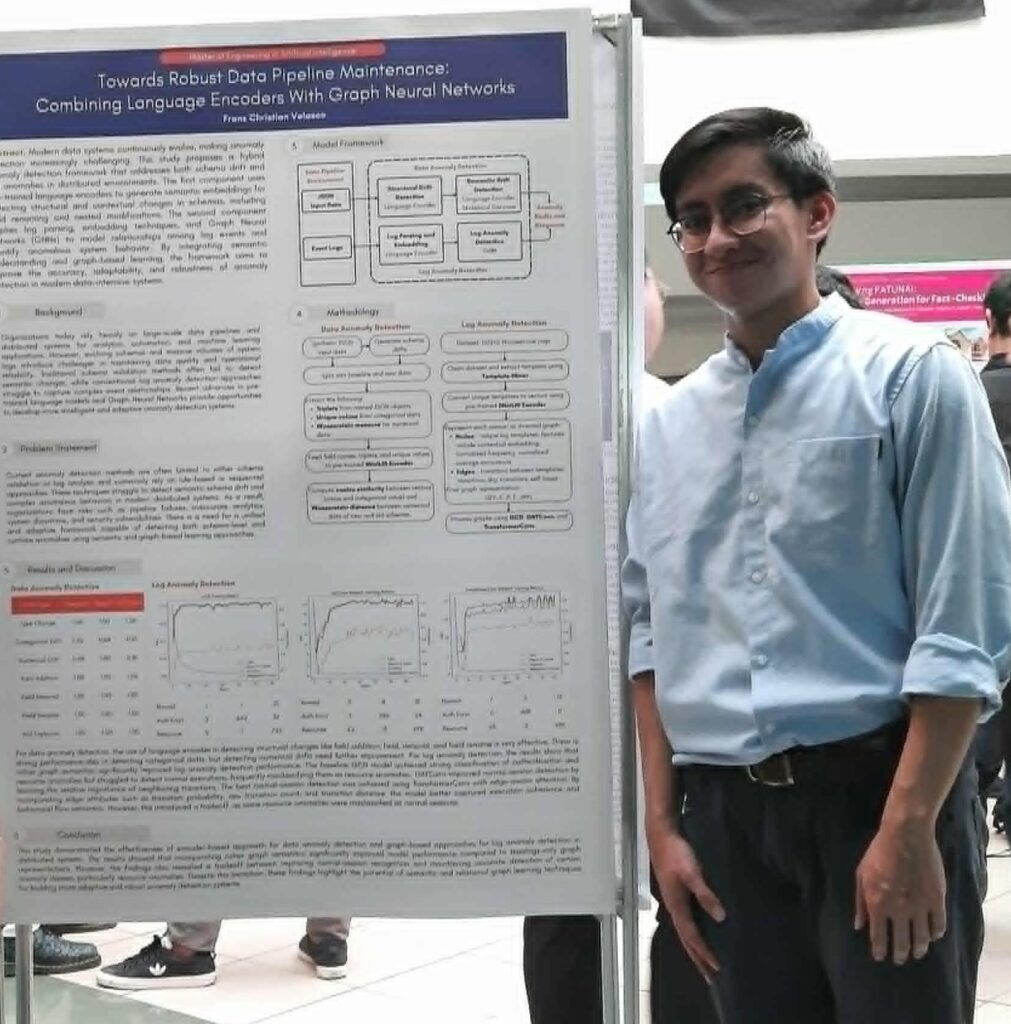
I decided to pursue the Master of Engineering in Artificial Intelligence (MEng AI) program primarily because I wanted to understand how the state-of-the-art AI models work. I was still employed as a mobile app developer when I started taking the courses, thinking that I’ll only be devoting my spare time to my graduate studies. But after a few semesters, I realized that I have to be a full-time student if I want to make the most of the program. Fortunately, I heard that Ayala Corporation has partnered with UPERDFI to provide scholarships for AI graduate students. This made it possible for me to focus on my remaining courses and my capstone project.
My project explores the use of AI in detecting anomalies within data pipelines using distributed systems. As organizations increasingly rely on digital systems to manage information and deliver services, ensuring the reliability of these systems has become more important than ever. From online banking and e-commerce platforms to healthcare and government services, modern applications continuously generate large amounts of data and system logs. However, hidden anomalies within these systems can lead to incorrect analytics, service interruptions, security vulnerabilities, and costly operational failures. This project focuses on detecting anomalies in two critical areas: data schemas and system logs.
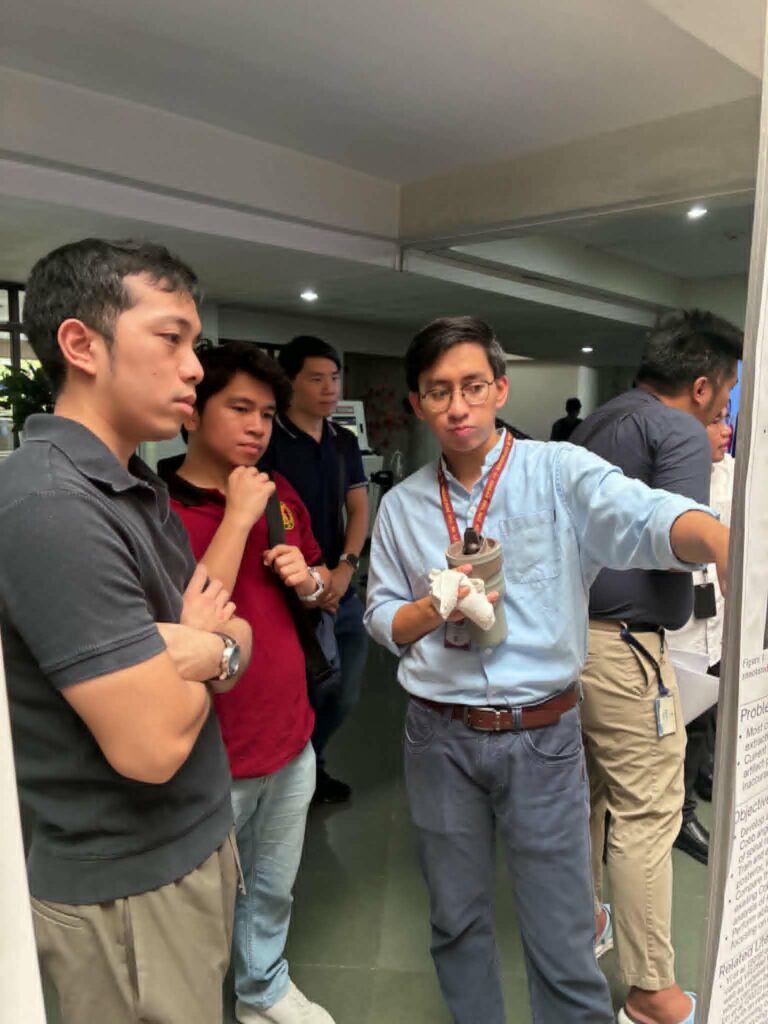
The first part of the project focuses on schema drift detection. A schema serves as the blueprint that defines how data is organized. As software systems evolve, schemas often change through the addition, removal, or modification of fields. These changes can unintentionally break data pipelines and cause inconsistencies across applications. To address this problem, the project uses pre-trained language models to understand the meaning and relationships of schema attributes, enabling the detection of both structural and semantic changes that traditional rule- based methods may overlook.
The second part focuses on log anomaly detection. System logs record events that occur during software execution and are widely used to diagnose failures and monitor system health. Because modern systems generate thousands of log entries every second, manually reviewing them is impractical. The project transforms log events into graph structures and applies Graph Neural Networks (GNNs) to learn patterns of normal system behavior and identify unusual activities that may indicate errors, failures, or malicious actions.
By combining semantic understanding of data structures with graph-based analysis of system behavior, this project demonstrates how AI can provide a more comprehensive and adaptive approach to anomaly detection. The proposed framework has potential applications in data engineering, cybersecurity, cloud computing, and large-scale software systems, helping organizations identify problems earlier, improve system reliability, and reduce operational risks.
The success of the project would not have been possible without the Ayala-UPERDFI scholarship. Now, I am about to start a new chapter in my career as a Data Analyst, and I am excited to apply the theories, tools, and techniques I learned in the AI Program.
===

Franz is a graduate of BS Industrial Engineering from UPLB, a former Instructor in the Department of Industrial Engineering in the said university, and a former mobile app developer. Beyond the field of engineering and programming, he is very much interested in philosophy and religion, and loves to read and write about them. His desire to understand the technical aspects of AI and its broader philosophical implications has prompted him to pursue advanced studies in the field.