by Angelo Aranilla and Lance Jonathan Gaspar, BS Computer Engineering students from UP Diliman, recipients of William Cua Scholarship
Meet our scholars and discover the thesis projects that showcase their hard work, innovation, and dedication.
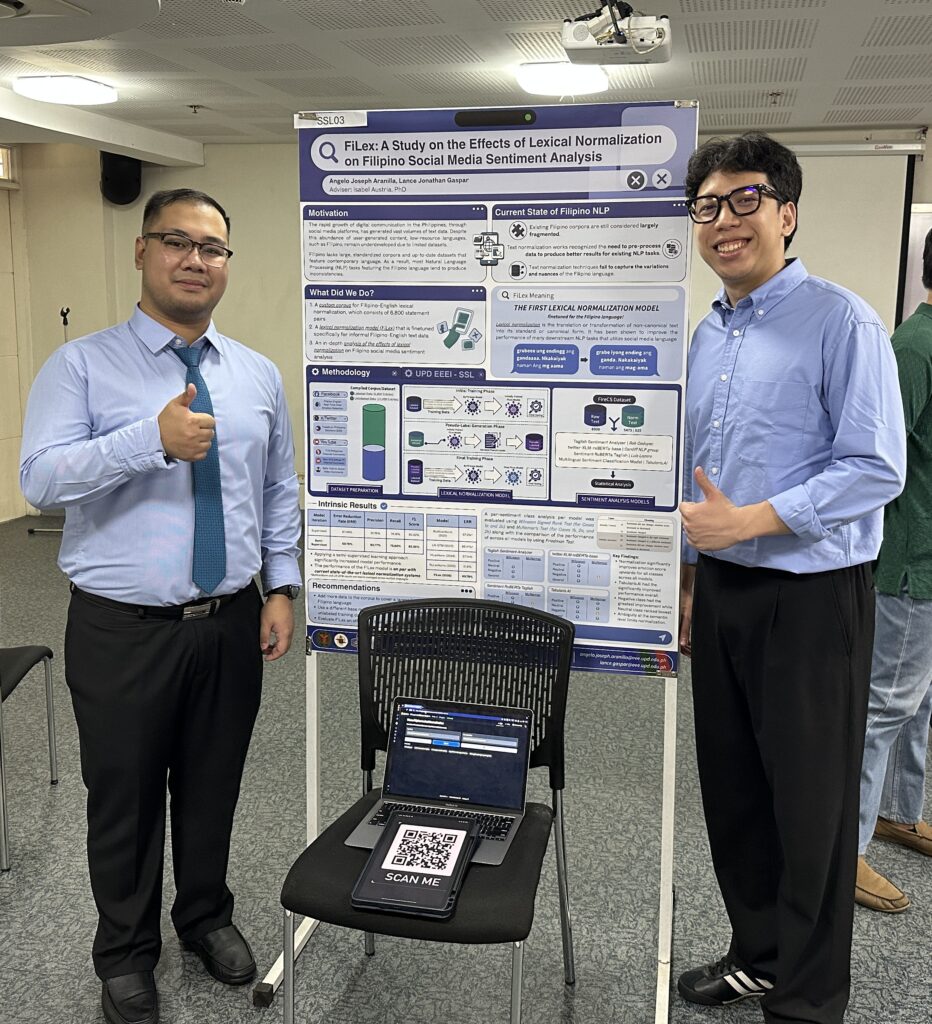
Undertaking an undergraduate thesis is never easy, especially for nuanced and underexplored fields, such as Filipino Natural Language Processing (NLP). Our study, FiLex: A Study on the Effects of Lexical Normalization on Filipino Social Media Sentiment Analysis, was born out of a shared curiosity about how to make NLP more inclusive of our own language and culture.
From the start, we knew we were taking on a technically demanding project. The heart of our study lay in lexical normalization: transforming non-standard words into their recognized forms so that NLP systems can better understand informal language. Applying this to Filipino social media text, with all its informal spelling, code-switching, and creative abbreviations, proved to be incredibly complex and pushed us to think deeper and consider all possible ways to complete the project.
One of our biggest hurdles came during the training phase and model development. Since this project was the first lexical normalization model for the Filipino language, building and training an effective AI model from scratch requires substantial manpower and computational infrastructure; resources that are not always accessible to students working on a tight budget. Creating training data from scratch meant that we needed to dedicate a large amount of time to ensure the data was consistent and of high quality. And without a reliable graphics processing unit (GPU), training runs that should have only taken a few hours stretched into something far less feasible.
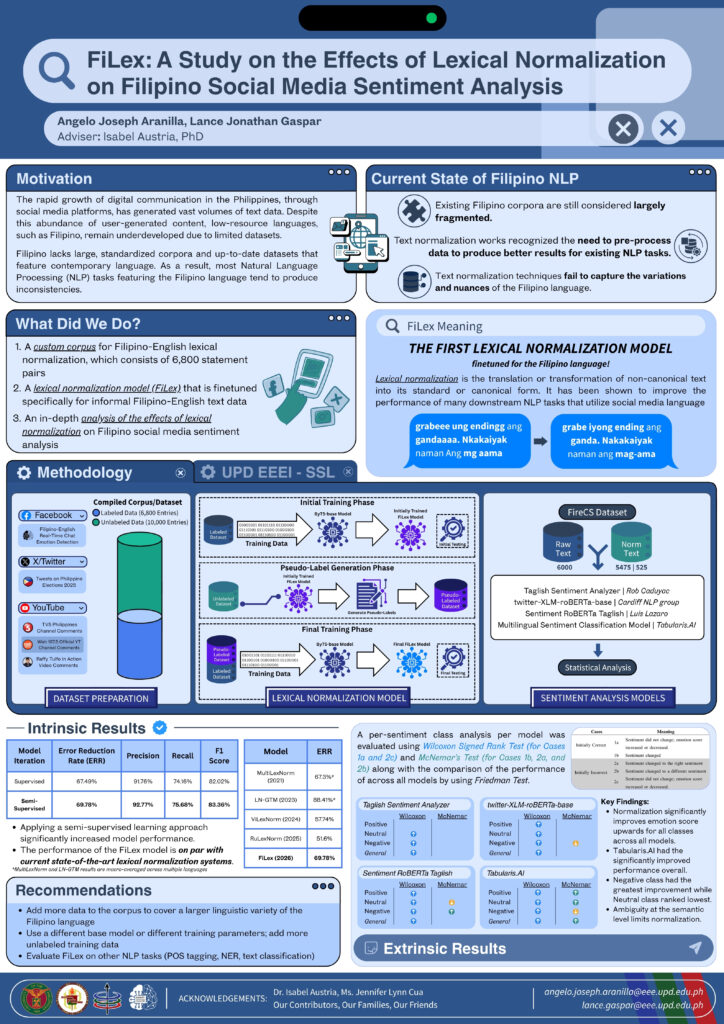
This is where the UP Engineering Research and Development Foundation, Inc. (UPERDFI) scholarship grant made all the difference. This funding enabled us to access the tools and infrastructure required for the project. More than just financial assistance, it was a vote of confidence in our work and in us as researchers. The grant allowed us to secure the manpower and GPU costs we needed to keep our development timeline on track and focus our energy on producing research that could genuinely contribute to the field of Filipino NLP.
Looking back, completing FiLex was one of the most challenging and rewarding experiences of our academic journey. We learned not just about our field of interest, but about persistence, collaboration, and the value of having people and institutions believe in our work. We are deeply grateful to the UPERDFI for being part of our journey, not just for their financial assistance, but for the trust they placed in us and in the value of our research. Because of their support, what once felt like an overwhelming challenge became a study we are proud to call our own.
Read the full Study HERE.
===
Angelo Aranilla is a graduating BS Computer Engineering student from UP Diliman with a strong interest in the field of artificial intelligence and deep learning. As an avid learner, he is passionate about exploring emerging technologies. He enjoys exploring innovations across diverse fields and applying technology to solve real-world problems.
Lance Jonathan Gaspar is a senior BS Computer Engineering student from UP Diliman with a strong foundation in software, systems, and data management. He thrives in collaborative environments, brings hands-on research and documentation experience, and is a highly adaptable quick learner eager to take on new challenges.