by Christian Falseco and Chrisa Venus, BS Computer Engineering students from UP Diliman, recipients of The Luisa Yao Que-Sanchez Thesis Support Grant.
Meet our scholars and discover the thesis projects that showcase their hard work, innovation, and dedication.
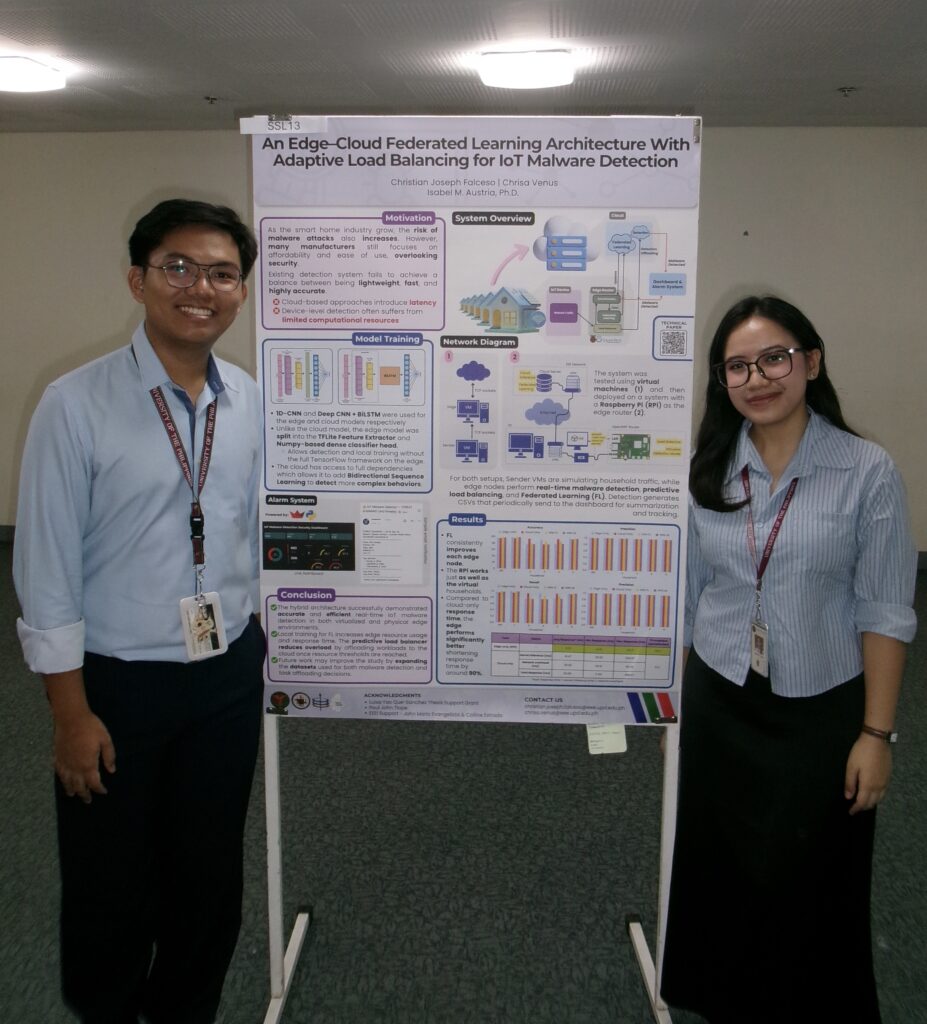
Smart homes continue to become more connected, but this convenience comes with increasing cybersecurity risks. As more devices rely on internet connectivity for everyday functions, malware attacks targeting IoT systems have become a growing concern. Our project, An Edge–Cloud Federated Learning Architecture With Adaptive Load Balancing for IoT Malware Detection, was inspired by this challenge.
Rather than focusing solely on developing a malware detection model, we set out to build a complete system that would best simulate realistic environments. This meant designing detection models for both edge and cloud deployment, implementing federated learning to preserve privacy, developing a predictive load balancer to manage workloads, and deploying the system on actual hardware. Each component introduced its own set of challenges requiring us to learn technologies and concepts apart from what we had initially expected.
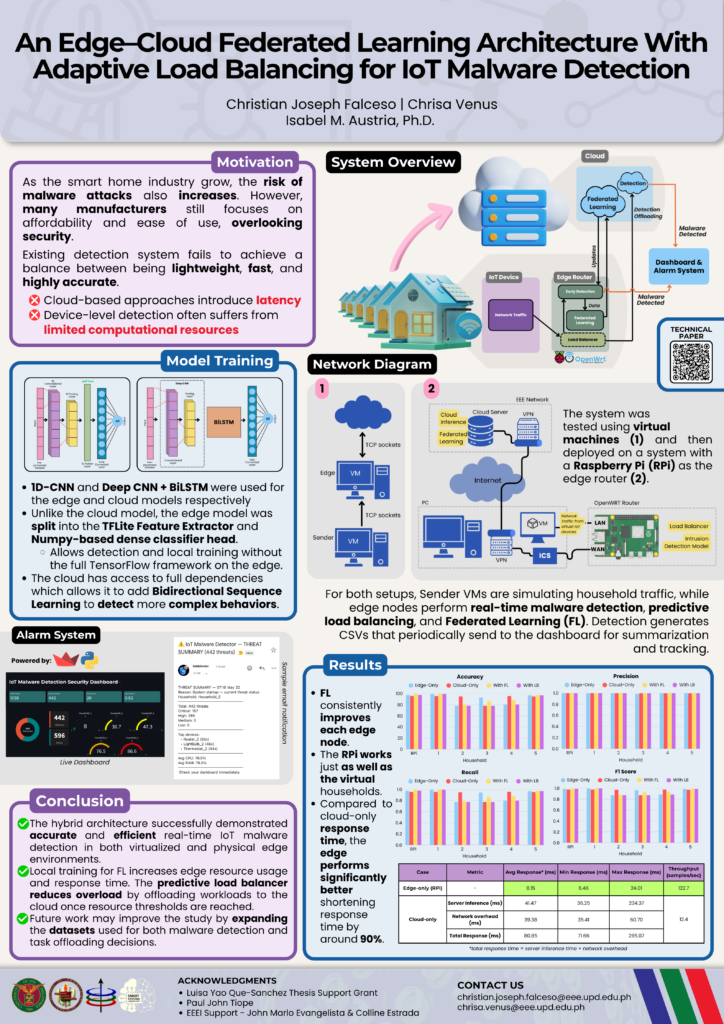
Among the most demanding aspects of the project was bridging the gap between theory and deployment. Training accurate models was only one part of the problem, making them run on resource-constrained devices was another challenge entirely. We spent countless hours troubleshooting compatibility issues, optimizing software for embedded systems, and finding ways to perform local training without the full machine learning frameworks typically available on more powerful computers. Along the way, we encountered networking, deployment, and performance challenges that often required us to rethink our approach and develop creative solutions.
The support provided by the UP Engineering Research and Development Foundation, Inc. (UPERDFI) played an important role in making this possible. The grant helped us secure the resources needed to develop, test, and validate the system, namely the Raspberry Pi we used as well as Google Colab units for model training and testing, allowing us to focus on solving technical problems rather than being limited by available equipment. More importantly, it gave us the opportunity to pursue a project that pushed us beyond the classroom and into the realities of engineering research and development.
Looking back, the project was as much about growth as it was about technology. It challenged us to apply knowledge from multiple fields, work through setbacks, and transform an ambitious concept into a functioning system. We are grateful to UPERDFI for supporting our research and for helping us bring this project to completion. The experience has strengthened our technical as well as our confidence as future engineers and researchers.
Read the full Study HERE
===
Christian Falceso is a BS Computer Engineering student from the UP Diliman with interests in artificial intelligence and cybersecurity. Alongside his technical pursuits, he has held leadership roles in student organizations, where he developed skills in project management and collaboration. He is particularly interested in leveraging intelligent technologies to address modern security challenges.
Chrisa Venus is a BS Computer Engineering student from UP Diliman whose interests include the Internet of Things (IoT) and intelligent computing technologies. Beyond academics, she actively engages in organizational work and leadership initiatives. Driven by curiosity, she continuously explores emerging technologies and their potential real-world applications.