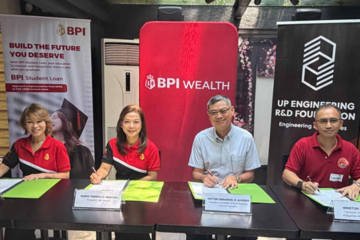
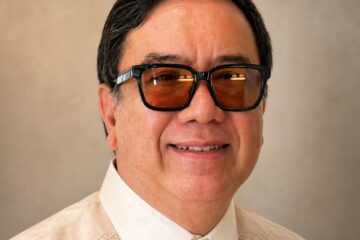
A special tribute from Chairman Lito Bermudo.
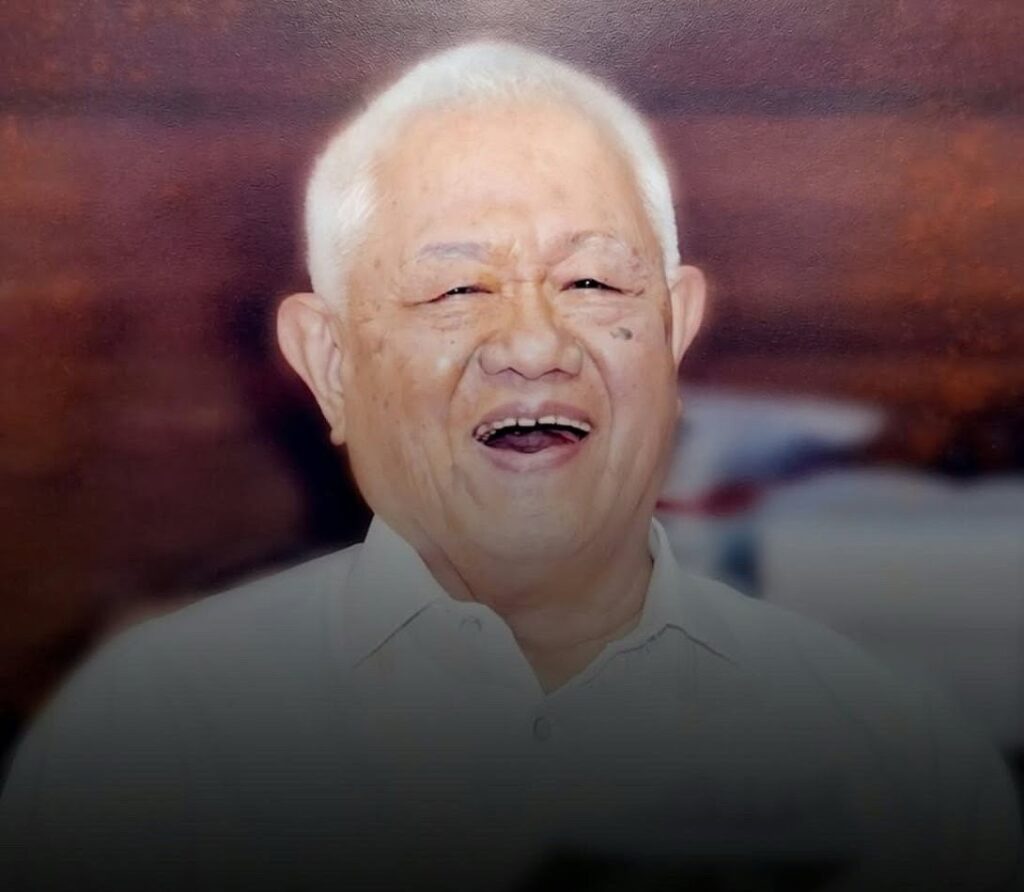
There are lives that are best remembered not by the offices a person held, but by the standards he represented.
Cesar Enrique Aguinaldo Virata belonged to such a generation.
He died on October 2 at the age of 95, bringing to a close a remarkable life in academe, business, government and public service. For more than half a century, he was part of the story of the Philippine economy—and, in a very personal way, part of the story of the University of the Philippines and of the UP Engineering Research and Development Foundation, Inc. (UPERDFI).
He was, first and foremost, a UP man.
A graduate of the UP College of Engineering and the UP College of Business Administration, garnering both degrees in 1952, Virata later became dean of the latter. He went on to SGV & Co., where he became the head of its Management Services Division, before entering government in 1967 to be the founding Managing Head of the newly-established Board of Investments (BOI). He served as Finance Secretary and Finance Minister from 1970 to 1986 and as Prime Minister from 1981 until the end of the Marcos administration in 1986. He also represented the Philippines in the World Bank and the Asian Development Bank.
These were not ordinary years.
They were years of extraordinary economic ambition, rapid industrialization, severe external shocks, mounting debt, political upheaval and, ultimately, national crisis. Virata stood at the center of economic policymaking through much of that turbulent period.
History will—and should—judge that period with all its complexity.
Virata served under Ferdinand Marcos for many years. That fact cannot simply be wished away. Nor should it be. There will always be those who regard his service in the Marcos government as complicity in the excesses and failures of the dictatorship. Others will remember him primarily as a technocrat who tried to bring economic discipline, institutional competence and professional judgment into a political system whose larger direction was not his to determine.
Both perspectives form part of the historical record.
But perhaps, on the occasion of his passing, we can allow history to be more discerning than partisan.
Virata was not a politician in the conventional sense. He was an economist, an engineer, an educator and a technocrat who believed deeply in the value of institutions and professional competence. Scholarship on the Philippine technocracy describes how his network brought together academe, business and government during the Marcos years.
His career also illustrates one of the perennial dilemmas of public service: What does a professional do when asked to serve a government whose political character is deeply contested?
There is no easy answer.
Some leave. Some resist. Some accommodate. Some try, from within, to make institutions work and economic policy better than it might otherwise have been.
Virata chose to serve.
That choice is part of his legacy, and history has every right to debate it. But it need not be the only thing remembered about him.
Because beyond politics was a long record of institution-building.
He helped shape economic policy during some of the country’s most difficult years. He dealt with international financial institutions, debt, investment, energy and industrial development. He promoted the role of technology and management in economic progress. Even after leaving government, he remained active in academe, business and institutions concerned with national development.
And he never really left UP.
For UPERDFI, that connection is especially meaningful.
The Foundation was established in 1972 under the leadership of UP College of Engineering Dean Alfredo L. Juinio, with its early resources coming from engineering alumni and private engineering firms. Its purpose was—and remains—to mobilize private support for engineering education, research and development at UP.
Virata was among the distinguished early generation of UP alumni and leaders who helped give substance to the idea that universities cannot build nations alone. They need the partnership of industry, government and alumni who are willing to invest not merely in buildings or programs, but in people and ideas.
That spirit remained with him throughout his life.
Even in his later years, Virata continued to support UP. In 2024, he established the Cesar E. A. Virata Professorial Chair in Industrial Engineering through UPERDFI—a fitting gesture from an engineer-turned-economist who understood the power of combining technical knowledge with sound management and economic thinking.
Those of us in UPERDFI will remember him not simply as a former Prime Minister or Finance Minister.
We will remember him as Sir Cesar—an elder of the UP community, a quiet and courteous presence, generous with his counsel, proud of his University, and deeply interested in the country’s future.
There was something characteristic about his manner. He did not need to dominate a room to command respect. His authority came from knowledge, experience and the quiet confidence of a man who had spent a lifetime dealing with difficult problems.
Perhaps that is also why his legacy deserves to be approached with a measure of humility.
Public figures are rarely one-dimensional. Neither are nations. The Philippines that Cesar Virata served was a complicated country, and the years in which he served it were even more complicated. To reduce a 95-year life to the political controversies of one chapter would be to diminish both the man and the history he helped shape.
We can acknowledge the controversies without allowing them to erase the contribution.
We can recognize the shortcomings of the era without denying the professional integrity and intellectual ability of the individual.
And we can disagree with some of his choices while still being grateful for the things he gave to the institutions he cared about.
That, perhaps, is what a mature nation does with its history.
It remembers.
It examines.
It learns.
And then it moves forward.
Cesar Virata spent his life believing that competent people, sound institutions and educated Filipinos could make a difference. For a man who began as an engineer at UP and went on to help steer the Philippine economy, that belief was more than an abstraction. It was a life’s work.
For UPERDFI, his legacy carries an additional responsibility.
The best way to honor the founders and early builders of the Foundation is not merely to remember them. It is to continue what they started: to invest in knowledge, nurture talent, strengthen engineering education and research, and use these in the service of the Filipino nation.
That is the most fitting farewell.
Thank you, Sir Cesar, for your service to UP, to UPERDFI and to the Philippines.
May the generations who follow remember not only the positions you held, but also the institutions you helped build, the students and educators you supported, and the enduring belief that you shared with so many of us:
that knowledge, when placed in the service of the nation, can help engineer a better Philippines.
Farewell, Sir Cesar.
And thank you.